
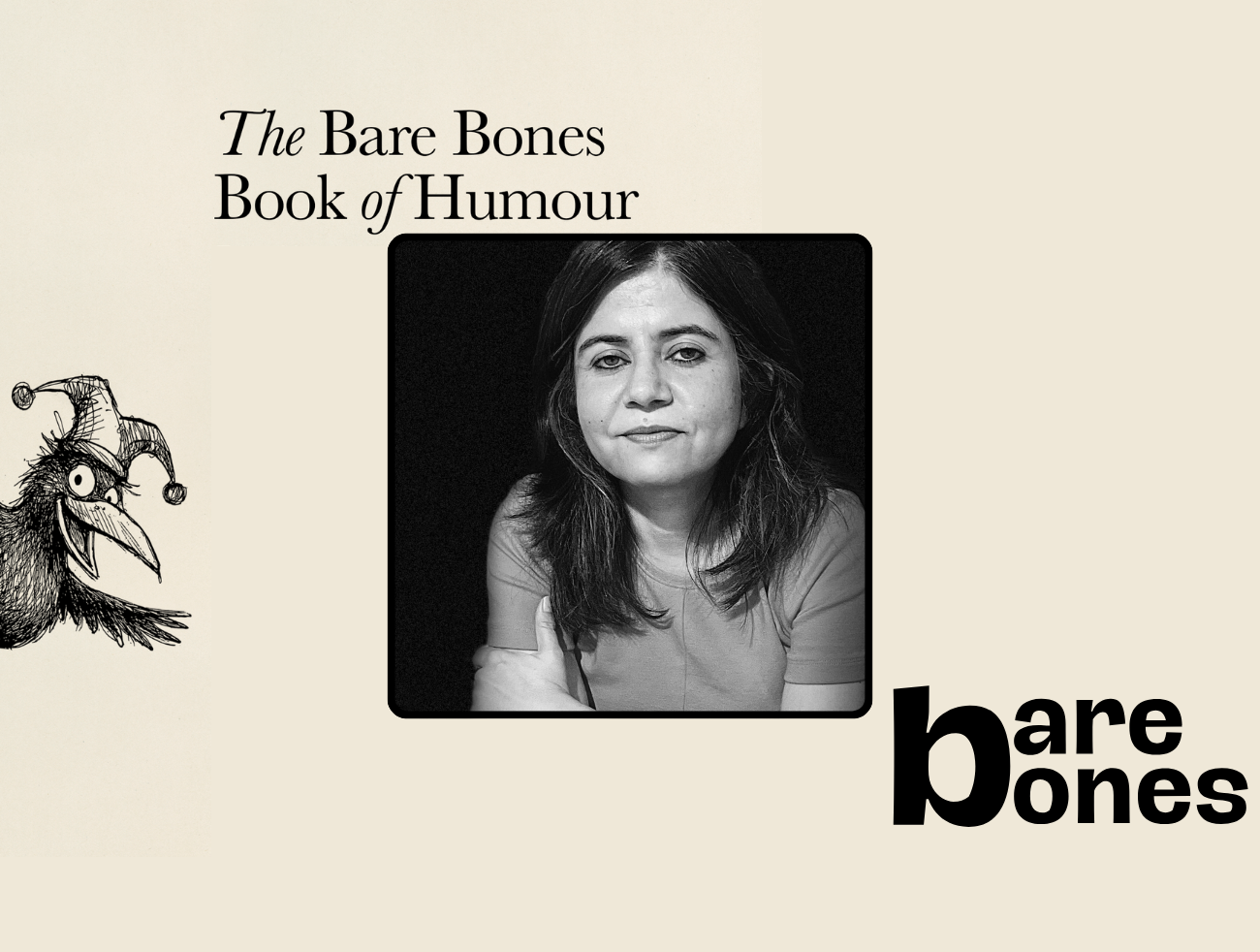
Aparna Kalra is a journalist who lives in Delhi.
In her story ‘Protection’, featured in THE BARE BONES BOOK OF HUMOUR, a policeman and a lover hunt for a missing condom with the clock ticking. The anthology’s editor Ankit Raj Ojha interviewed her about finding comedy in awkward crises.
Tell us about your perspective on humour and its place in writing and in life.
Humour is what makes an increasingly fascist world bearable. Humour writing is tough but worth it. Jaane Bhi Do Yaaron is fondly remembered and considered a cult movie because it delivered black humour in a broken system.
I love the work of stand-up comics in India; they have jibed at the Right Wing more than journalists have. And proven more courageous.
It is telling that those in power hate jokes, because humour is subversive. It can reveal when power is being misused. That is why comics are jailed and cartoonists sacked from their jobs. Powerful politicians do not like being lampooned.
What are the things, works, and authors that have influenced your writing?
I am a journalist, so news of government diktats, which form the basis of policy, fascinate me. Policy which impacts our freedom is always made palatable for the public first by giving it a veneer of safeguarding us.
I am fond of a number of writers, not necessarily comic ones. Mohammed Hanif and Daniyal Mueenuddin are among my favourites—the appeal of Pakistani writers is that their social context and writing closely mirrors ours. American writer Jason Reynolds, who writes for Young Adults or the YA category, has influenced me considerably. I love his stories and his opinion that a story for any section of readers, children, YA, or grown-ups, can be anything but can’t be boring.
Mick Herron is so, so good. His London is so dark and dirty.
Hansda Sowvendra Shekhar, Saba Sams, and Xiaolu Guo are among my favourite short story writers. Of course, ‘Lihaaf’ by Ismat Chughtai will always be one of the most impressive short stories to be written in the Indian sub-continent.
I loved Benyamin’s novella, GOAT DAYS. I have read India’s recent Booker winners, Geetanjali Shree in Hindi—I ploughed through her novel because I loved the mother–daughter dynamic—and Banu Mushtaq in English, and found them amazing. Banu Mushtaq’s stories are vivid, and often satirical, and funny. She is a feminist hiding in plain sight.
Is there any image, phrase, idea, place, person, or memory that became the seed for ‘Protection’?
I wanted to touch upon the absurd ways governments now control us—we can try coping with these extreme measures by protesting, but also by laughing at them. And all this control is done in the name of protecting us, and keeping the social order intact, when societies can only benefit from change.
The story title also plays on what condoms are used for. I find it perplexing that condoms, so useful for channelling desire, are hardly ever mentioned, even in rom-coms. You may recall how brave Ranveer Singh, the Hindi film actor, was considered, for doing a Durex ad; the admiration bordered on awe. You would almost think Singh had never used a condom personally. What a ridiculous idea, it can only come from mindsets that promote hypocrisy.
We are a country obsessed with marriage but will frown on, and gossip about, any relationship other than one involving so-called nuptial bliss—bliss which is actually very rare. That is also what drove me.
And, oh yes, I love dogs. Indie dogs are my favourite because of their rambunctious personality.
I wish more people loved Desi dogs, and gave them a home. Instead, we have advertisements showing only Labradors, and celebrities (except John Abraham) posing with their exotic dogs. India is a hot country and we can be kind to foreign, long-haired breeds by not letting breeders sell them to us.
Those who love dogs, like me, should read THE FRIEND by Sigrid Nunez.

Leave a Reply