
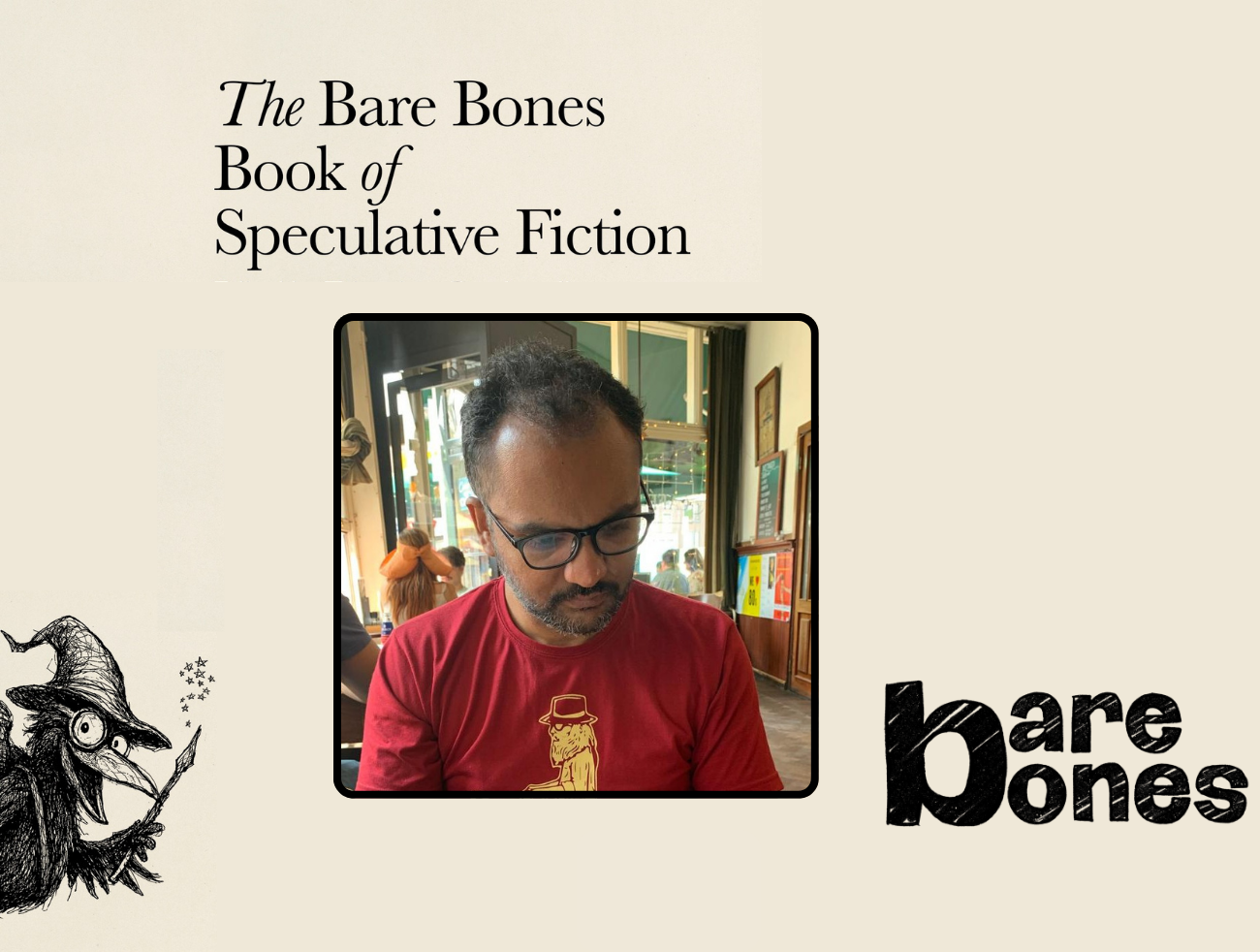
When Jayadev Calamur isn’t crafting communication strategies, he’s building fictional worlds where magic has rules, and John Lennon’s Imagine is law. A former journalist turned storyteller, Jayadev explores the collision of hope, chaos, and conscience. He lives in Pune with his wife and their dog, championing worlds where no pet is ever abandoned.
Jayadev’s story ‘The Immortal Bureaucrat’—in which an old man finds himself dealing with bureaucratic apathy in the afterlife—features in THE BARE BONES BOOK OF SPECULATIVE FICTION. The anthology’s editor Tejaswinee Roychowdhury interviewed him to find out about his literary influences.
How do you perceive speculative fiction vis-à-vis the world around you?
Speculative fiction, to me, is less about distant futures and more about examining the present from a different vantage point. By stretching reality, it allows us to ask questions about power, institutions, and human behaviour that might be harder to confront directly in realist fiction.
The genre creates a certain distance from the everyday world, and that distance often sharpens our view of it. Whether one is writing about bureaucracy, politics, identity, or the passage of time, speculative fiction allows us to explore the systems we live within and the people navigating them. At its best, it is a way of looking at reality more clearly.
Who and/or what are some of your influences while writing speculative fiction?
My influences tend to be writers and creators who use imagination not merely to build fantastical worlds, but to examine the one we live in. Authors such as J.R.R. Tolkien, George Orwell, Isaac Asimov, Douglas Adams, Satyajit Ray—particularly his Professor Shonku stories—and Ursula K. Le Guin have shaped how I think about speculative storytelling. Their work spans mythic world-building, political allegory, scientific curiosity, and philosophical reflection, yet all of it ultimately circles back to very human questions.
I have also enjoyed the wit and inventiveness of Jonathan Stroud’s Bartimaeus trilogy, and the expansive cinematic storytelling of George Lucas, whose work demonstrated how speculative ideas could resonate with a broad global audience.
The Harry Potter books also played an unexpected role in my journey as a reader. Around 2005, when Harry Potter and the Order of the Phoenix was released, I discovered the world of fan fiction and encountered remarkably creative writers from across the world who were expanding that universe in imaginative ways.
What connects all these influences for me is their ability to use imagined worlds as a way of illuminating very real human questions.
Tell us about the creative process behind your story.
My writing process often begins with a mixture of daydreaming and observation. I tend to watch how people behave, how institutions function, and how small details reveal larger truths about the systems we inhabit. Quiet observation, more than anything else, becomes the raw material for my scenes.
‘The Immortal Bureaucrat’ is, in a quiet way, a tribute to my father. His name was C.R. Gopalakrishna, though everyone affectionately called him Gopal, which is why the protagonist’s name. My father had a deep respect for order, paperwork, and the idea that systems worked best when people took responsibility for them. After retiring, he even volunteered with the Dignity Foundation in the early 2000s, helping senior citizens obtain their identity cards, long before Aadhaar existed. I also remember how, when our building discussed redevelopment, he took it upon himself to ensure every resident had their documentation in order.
The story imagines a bureaucrat who outlives the systems he serves. Emotionally, it draws from a more personal place. My father had fragile health, and writing the story, I found myself imagining a gentler ending for the character, one where Gopal simply dies peacefully in his sleep, without suffering. The story became a way of reflecting on the quiet dignity of people who dedicate their lives to the small but essential work of keeping things in order.

Leave a Reply