
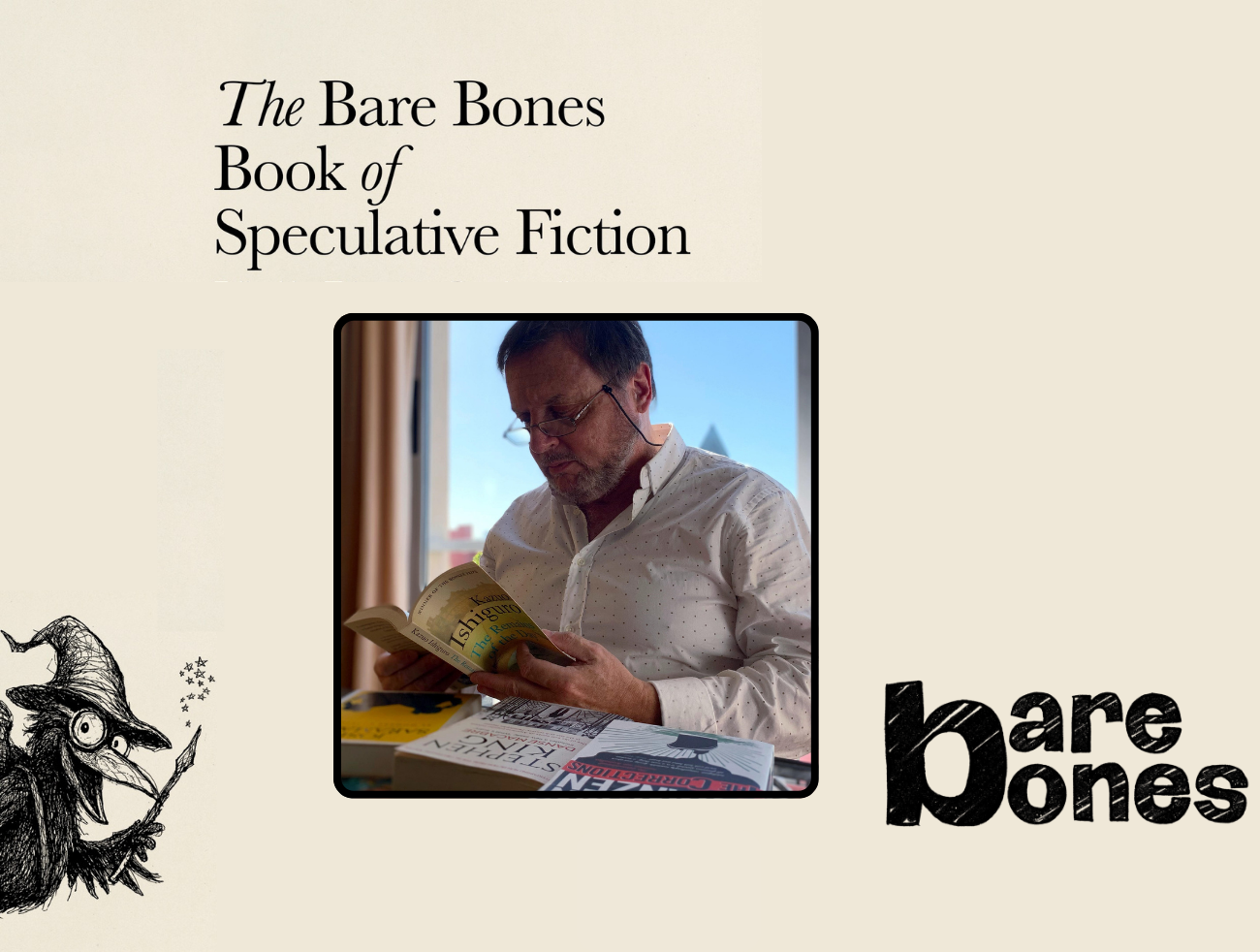
Marcelo Medone (Buenos Aires, Argentina) is a Pushcart Prize- and Best Small Fictions-nominated fiction writer, poet, essayist, and screenwriter. He has received numerous awards and has been published in multiple languages in more than 50 countries around the world, including India. He currently lives in Montevideo, Uruguay.
Marcelo’s story ‘On the Outskirts of San Junipero’—in which the protagonist and her partner are the last hope against androids, or so she thinks—features in THE BARE BONES BOOK OF SPECULATIVE FICTION. The anthology’s editor Tejaswinee Roychowdhury interviewed him to find out about his literary influences.
How do you perceive speculative fiction vis-à-vis the world around you?
Both in my home country of Argentina and in my current home in neighbouring Uruguay, I have surrounded myself with writers and enthusiastic publishers of speculative fiction—particularly short stories—a genre with a long-standing tradition on both sides of the River Plate. I am also in contact with numerous writers and publishers of the genre from all over the world. I prefer the fantasy genre, magical realism, science fiction, and horror; I am hardly at all drawn to fantasy featuring wizards, elves, dragons, and epic battles.
Who and/or what are some of your influences while writing speculative fiction?
As a writer, my interests and output span short stories, flash fiction, novels, poetry, plays, feature and short film scripts, essays, and newspaper articles. I have been fortunate enough to have been published over 1,000 times to date, in 58 countries and in eight languages.
Although speculative fiction is my favourite genre, I also write crime, erotic, children’s, and mainstream short stories.
My major influences as a writer of speculative fiction include Argentine short-story writers such as Jorge Luis Borges, Adolfo Bioy Casares, Silvina Ocampo, Julio Cortázar, Angélica Gorodischer, and Samanta Schweblin; Uruguayan writers such as Mario Levrero, Felisberto Hernández and Rafael Courtoisie; and, from the English-speaking world, Ray Bradbury, Isaac Asimov, Philip K. Dick, Stanislaw Lem, John Varley, Octavia Butler, Margaret Atwood, and Ted Chiang.
Tell us about the creative process behind your story.
With regard to my short story ‘On the Outskirts of San Junipero’, a few years ago I wrote a 100-word story entitled ‘Two Hearts Beating’ which explored the central theme of the story: the ambiguity of distinguishing between a human and an android, and the question of when a human embryo or foetus is recognised as a human being whilst still inside its mother.
The title and the setting of the story in San Junipero—which, beyond its actual existence in the Sonoran Desert in Mexico, is an allusion and a tribute to one of the most memorable episodes of the British series Black Mirror, which I greatly admire.
I also drew inspiration from Philip K. Dick’s novella SECOND VARIETY, which explores the difficulty of determining whether someone is a human being or an advanced android—a theme also explored in his novel DO ANDROIDS DREAM OF ELECTRIC SHEEP?, which inspired the film Blade Runner. This difficulty in distinguishing between human and machine also features in the films of the Terminator series, where dogs are used to detect androids from the future.
If we go further back in time, the difficulty of differentiating between human intelligence and the artificial intelligence that mimics it dates back to Alan Turing’s famous test, also cited by Dick.
Ultimately, it comes down to the most fundamental question of all: What makes us human?

Leave a Reply