
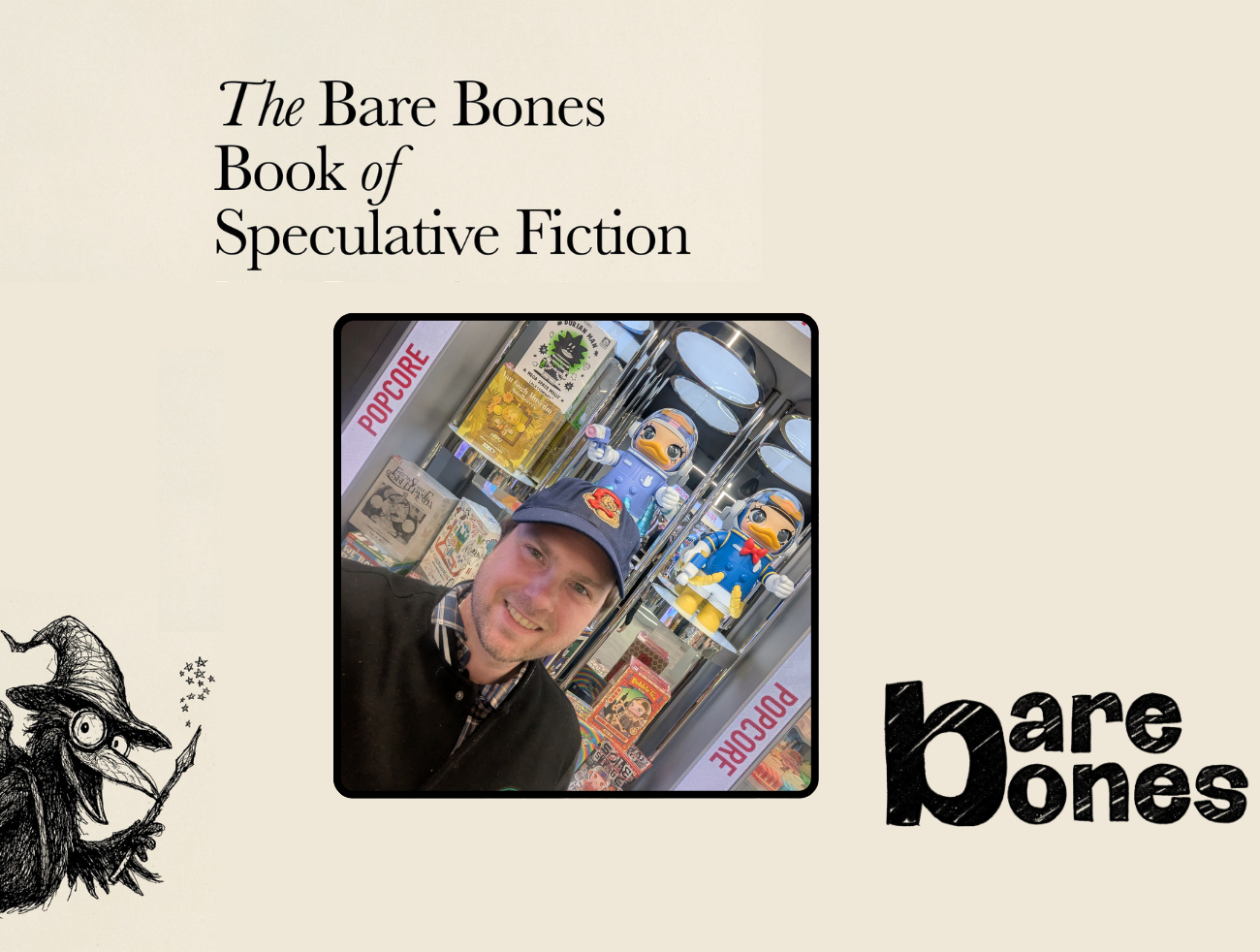
Matthew Gordon’s short fiction has appeared in Amazing Stories, High Shelf Press, The Quilliad, Witcraft, The Artisanal Writer, Reverie, Black Cat Weekly, Mobius Blvd, Ashton House Magazine, and Iron Faerie’s Hawthorn & Ash Collection. He is a member of the Science Fiction Writers of America. He has lived in Ontario, New York, Texas, and Alberta. He now lives in his hometown of Toronto, Ontario.
Matthew’s story ‘Hope Springs Infernal’—in which a man condemned to Hell is given an irreversible choice—features in THE BARE BONES BOOK OF SPECULATIVE FICTION. The anthology’s editor Tejaswinee Roychowdhury interviewed him to find out about his literary influences.
How do you perceive speculative fiction vis-à-vis the world around you?
I view speculative fiction broadly, meaning it can be any of science fiction, fantasy, horror, weird fiction, slipstream, historical fiction and/or alternate history, or, crucially, any combination of the above. I’ve never shied away from combining those genres, such as in my recent historical horror publication ‘Alive and Dead at Merganser Plain’ (Ashton House Magazine #1, December 2025) or in my recent urban social science fiction publication ‘Great Times’ (Black Cat Weekly #199, July 2025). Historically, a lot of speculative fiction got unfairly labelled as unserious genre fiction, but the increasingly speculative nature of recent-ish bestsellers like Erin Morgenstern’s THE NIGHT CIRCUS and Kate Atkinson’s LIFE AFTER LIFE has hopefully reversed that view. That’s how I view speculative fiction in the literary world around me: as anything removed from the day-to-day vagaries of people telling their regular life stories.
In terms of the natural world, it’s the classic question: What if? What if something we take for granted in life, as small as an insect’s wing function or as large as the presence of a mountain range, was somehow different—or not there at all? Once that premise emerges, going down the rabbit hole leads to all sorts of unprovable conjecture, but it’s conjecture based on observable fact. For example, adding a mountain range where one didn’t exist before will greatly impact rainfall trends in the area. We know that from observing the windward and leeward sides of the Canadian Rocky Mountains. How would those trends be affected in some completely other place? That’s where the speculation begins.
Who and/or what are some of your influences while writing speculative fiction?
That broad view of speculative fiction goes toward my influences, who are authors in all the speculative genres, more traditionally literary authors, and nonfiction writers like academic historians. For example, every single one of my historical fiction stories is based on an academic history book in terms of the setting and the external events; the characters and plot are what I add to make it a compelling fictional adventure.
For my more conventional influences while writing speculative fiction (i.e. other speculative fiction authors and books), the early science fiction pioneers like H.G. Wells (especially THE ISLAND OF DR. MOREAU and IN THE DAYS OF THE COMET) and Robert W. Chambers’s THE KING IN YELLOW are some of my favourite scene setters. For all speculative fiction has advanced in terms of cyberpunk and other techno-culture subgenres, some of the bleakest, scariest places got explored very early. Then there’s the next few waves, from classic science fiction like Robert A. Heinlein’s ‘And He Built a Crooked House’ all the way up through Daniel Keyes’s FLOWERS FOR ALGERNON, Robert Silverberg’s incredible decades-long career (especially DYING INSIDE) and Paul Auster’s IN THE COUNTRY OF LAST THINGS. Too many to name them all, but hopefully the common thread of character-setting interaction comes through.
Tell us about the creative process behind your story.
Some stories begin with a title. ‘Hope Springs Infernal’ was one of those. I ran with it, trying to think of the most hopeless situation someone could possibly be in, and then what unpredictable stroke of fate could extricate that person from that situation. I’ve always been big on setting as a character, so to write this sort of man versus nature story in a place based on the Eighth Circle of Hell from Dante Alighieri’s THE DIVINE COMEDY seemed like a natural place. In short, it’s the deepest our character can go into Hell while keeping the surroundings hot, as the Ninth Circle, Cocytus, is a ball of ice. I’ve made Hell cold in other stories, but given that our character wears a lead suit, heat feels more painful here. Anyone who’s touched a metal railing on a hot summer day knows that feeling; now imagine it all over your body, constantly, inescapably, for eternity. That’s how hopeless the character’s situation is.
Game theory has always been a huge influence on my writing, ever since I read short stories like Frank Stockton’s ‘The Lady, or the Tiger?’ and since I took a game theory course in graduate school. Entering my characters into these seemingly impossible, paradoxical puzzles forces them to advance the conflict while realising there are forces in this world greater than they are. For ‘Hope Springs Infernal’, I chose the Two Envelopes Game. That game isn’t nearly as often discussed as many other games, but it presents a tense interpersonal challenge. That challenge turns from a contest into torture when it’s presented as a one-player game: there’s truly no way to win. Yet because it’s Hell, our character is gifted a sort-of win.

Leave a Reply