
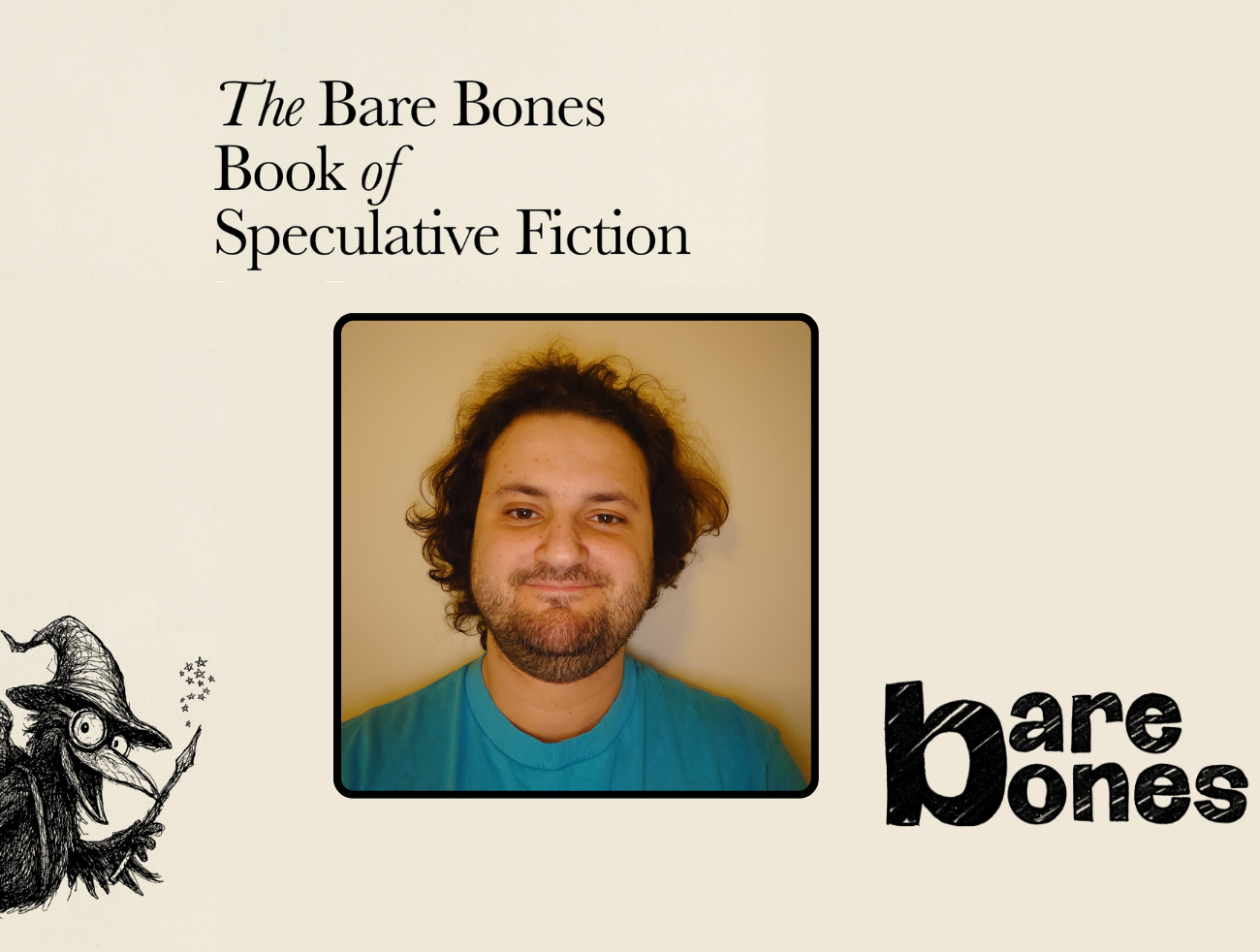
Evan Satinsky is a software engineer, musician, and writer of science fiction and fantasy from St. Louis, Missouri. He has stories published in The Heartwarming Stories Anthology by The Brussels Review and the Opolis Anthology by NUNUM.
Evan’s story ‘The Frozen Fens of Fhemai’—in which a freeze temporarily bridges the worlds of the living and the dead, allowing communication—features in THE BARE BONES BOOK OF SPECULATIVE FICTION. The anthology’s editor, Tejaswinee Roychowdhury, interviewed him to learn about his literary influences.
How do you perceive speculative fiction vis-à-vis the world around you?
Speculative fiction is part of the world around us! Just like we aren’t living in the universe but rather are a piece of the universe, just like there is not a true distinction between the ‘natural world’ and the ‘man-made’ world since we are part of nature, speculative fiction is a piece of the human world and therefore is influenced by and influences everything we do. Reading anything from escapist fantasy to dystopian science fiction can teach you about the human condition, and writing the most nonsensical, pulpy, silly swords-and-planets story will involve accessing and splicing in experiences from one’s entire life. There is no wall between fiction and reality, and that wall does not grow taller the more outlandish the fiction; rather, and much the opposite, fiction is a conduit through which we can communicate that reality—the more outlandish, the more tools with which to communicate.
At the same time, in my day-to-day life, I am a huge believer in escapism. Just because I can learn about and contribute to the sum total of human knowledge by engaging with speculative fiction does not mean I have to. It’s perfectly ok—some would even argue necessary, myself among them—to step back from the constant flow of information bombarding us from all sides and enclose ourselves in the unique, impermeable cocoon of a good story, one which feels, if we let it, nothing like the complex, unsatisfying, narrativeless mess of our outer life.
Who and/or what are some of your influences while writing speculative fiction?
My speculative fiction influences are quite direct—that is, when I need help creating a feeling or a writing style or a world element for a story, I tend to go right for those who’ve done it best in the style I’m currently trying to emulate. Do I like art beyond those styles? Of course. But my writing influences are those who fit my goals for my writing in particular.
Right now, I’m in quite a gothic, weird, literary, genre-bending writing mood, and have been for some time, so my influences tend to be similar to those baroque styles. Authors whose work I look to when I am struggling with my own voice include the greats of weird fiction, science fantasy, and those whose powers to describe the feeling of a scene are unparalleled. These include China Miéville, the father of the new weird and the best prose writer I’ve ever read; Ada Palmer, who can twist a realistic world into shapes which seem impossible in only three dimensions of imagination; Dan Simmons, whose prowess with descriptive, emotional prose and imaginative worldbuilding is perhaps peerless; and Tad Williams, who introduced elements of true horror into the subgenre of epic fantasy with perfection—among many others.
I also pull elements—mostly story, world, and vibe ideas–from other types of art. Coming across a classic painting by the likes of Max Ernst or Hieronymus Bosch, or modern masterpieces by Anastasia Trusova or Hedieh Javanshir Ilchi, has many times instantly injected story elements of surprising fervour into my mind. Not to mention, of course, the hundreds of book cover artists, whose work is designed specifically to remind one of a fantastical story, my favourite of whom right now are Paul Lehr, with his sweeping, colourful spacescapes, and Jeffrey Catherine Jones, whose empty, unsaturated spaces and undefined, weird shapes allow her paintings to capture the coldness of space better than anyone I’ve seen. Similarly, the lyrics and the instrumentation of some of my favourite songs have sown the seeds of stories into the furrows of my brain, most notably those by Knifeworld.
Tell us about the creative process behind your story.
My story, ‘The Frozen Fens of Fhemai’, was originally written as a bit of an experiment, my attempt to buck my own trend at the time of quite dark, lonely, depressing stories and write something a little more community-oriented and uplifting, without of course throwing away any of the vivid, thematic imagery I’ve been working on in recent years. I started, as I usually do, with an idea, a world which the story would inhabit. What if I wrote about winter and death, but in a way which could bring people together rather than force them apart? This would require quite a few characters and points of view—a city perhaps, or a small town at least. The idea began to form—and then I wrote.
Most of my creative process, in fact, is writing. When I try to sit and think about how a story should go, I tend to come up empty. The part of my brain which knows how stories go … well, perhaps predictably, that’s the part of my brain that reads. So, for me, writing is just reading, but with an empty page after the last word. I’ve read enough in my life now that this special book-laden corner of my consciousness knows what should probably come next, even if there are no words there to guide it. It takes over, and the words appear, and after years of practice, I can usually trust it to work within my flow state and create something comprehensible. Then I need only nudge those words into their perfect place at the end before I’m done.

Leave a Reply