
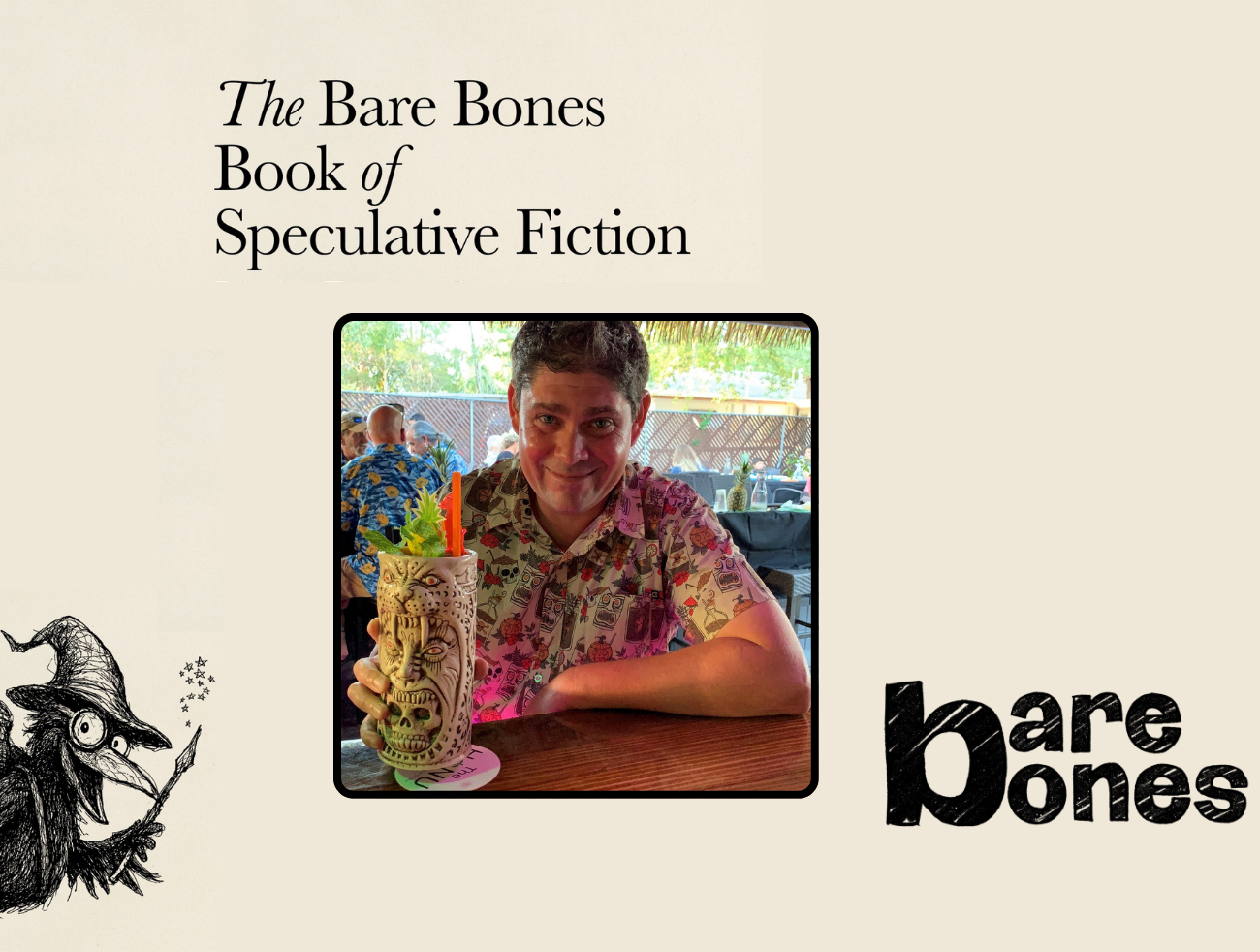
Joshua Ginsberg is the author of the short story collection Tales from the Dusty Tiger and six nonfiction books about curious travel and haunted history. His work has appeared on the NoSleep Podcast, in multiple anthologies, and in publications including Apex Magazine, Spooky, Stygian Lepus, Tension Literary, Crepuscular, Black Hare Press, Trembling with Fear, and Flash Phantoms. He lives in Tampa, Florida.
Joshua’s story ‘Retirement Party’—in which Death retires—features in THE BARE BONES BOOK OF SPECULATIVE FICTION. The anthology’s editor Tejaswinee Roychowdhury interviewed him to find out about his literary influences.
How do you perceive speculative fiction vis-à-vis the world around you?
Speculative fiction, from my perspective, comes down to the deceptively simple, two-word question, “What if?” How we answer that is an entirely subjective thing, though, and depends on everything from culture, ethnicity, religion, nationality, etc., to what we’re reading, watching on television or even having for breakfast. I think that’s a good thing, though, because it means that none of us is ever likely to answer the same question the same way twice.
The way I go about answering it usually involves a combination of different sources and ideas. For instance, maybe I just read something by Ursula K. Le Guin, and I listened to the song, ‘Nothing but Flowers’ by the Talking Heads, and saw something on television about a current war or conflict. Maybe those ideas swirl together and produce an idea for a story about a battle on a distant world where suddenly and to the surprise of both armies, all of their weapons spontaneously transform into some sort of flowers. I haven’t actually written that, but you can see how those various components might come together.
I also try to go a little bit further than “what if” and add a “but” to it. For example, what if extreme climate change causes mass migration, but the ones migrating are ghosts, doomed to endlessly repeat their flight (that was an idea I did write out as a story)? Or what if we successfully colonise space by terraforming planets, but the long-term effect of terraforming is that it destabilises the weather systems of those planets? These sorts of questions stem directly from the world around us, but the more we ask and consider such questions, the more our relationship to the world is challenged or changed. Sorry, long-winded answer, but that, to me, anyway, is how I see the relationship between speculative fiction and the “real” world we live in.
Who and/or what are some of your influences while writing speculative fiction?
The three writers who have had the most powerful impact on my writing, speculative or otherwise (at the moment), are probably Ray Bradbury, Clive Barker, and Angela Carter (weird mix, I know). From there, I branched out into Le Guin, Ellison, Dick, Aickman, and way too many others. I also went back and reread Mary Shelley, Poe, and a bunch of others. In terms of the artistry of short story writing, I look to writers like Carver and Chekhov. I love fairy tales too, from The Brothers Grimm and Hans Chrisitan Anderson to more modern versions like those from Italo Calvino and Kelly Link. And now every day I’m finding new writers, many of whom were influenced by the same writers I was. Eugen Bacon, Ken Liu, Kurt Fawver, Pedro Iniguez, Christina Sng, Elaine Pascale. Those are just a handful of the many writers working today who astound and inspire me.
Beyond writing, though, a lot of 1980s and 90s pop culture seems to find its way into my work, along with TV shows like The Twilight Zone, Tales from the Crypt, Amazing Stories, and Black Mirror, along with music and visual art. Really, all sorts of unexpected things, from ancient mythology to Shakespeare to movies like Blade Runner to VR video games, can trigger an idea and make me ask, what if?
Tell us about the creative process behind your story.
‘Retirement Party’ was an example of a few different ideas coming together in my head and spilling out onto the page as flash fiction. One of my long-time colleagues was retiring, so that idea was front and centre in my mind. At the same time, I was reading the H.P. Lovecraft story, ‘The Nameless City’, and that line “That is not dead which can eternal lie, and with strange aeons even death may die” really stuck in my head. I started thinking, well, what if death did die? How and why might that happen, and what would it look like? That was really all it took for this particular story to take form. As flash fiction, it’s under 1,000 words, so usually once I lock on to the idea, I can produce a first draft fairly quickly. Often in a single sitting. Then it’s a matter of revising and refining it, which involves a few rounds at least. Sometimes my wife or one of my friends will take a look at an early version and offer some feedback.
In terms of my fiction, I started off just a few years ago with shorter works—mostly flash fiction and even some drabbles (stories of exactly 100 words). I’ve found this to be helpful in terms of learning to be as swift and efficient as possible in storytelling. I also feel a lot more in control of something this size. As I’ve been developing more confidence, my stories have been getting longer and more complex, and therefore generally take longer to produce. With ‘Retirement Party’, I probably spent a day or two thinking about the idea, figuring out how the story would go, and then when I sat down to write it, it was already pretty well-formed in my head.

Leave a Reply