
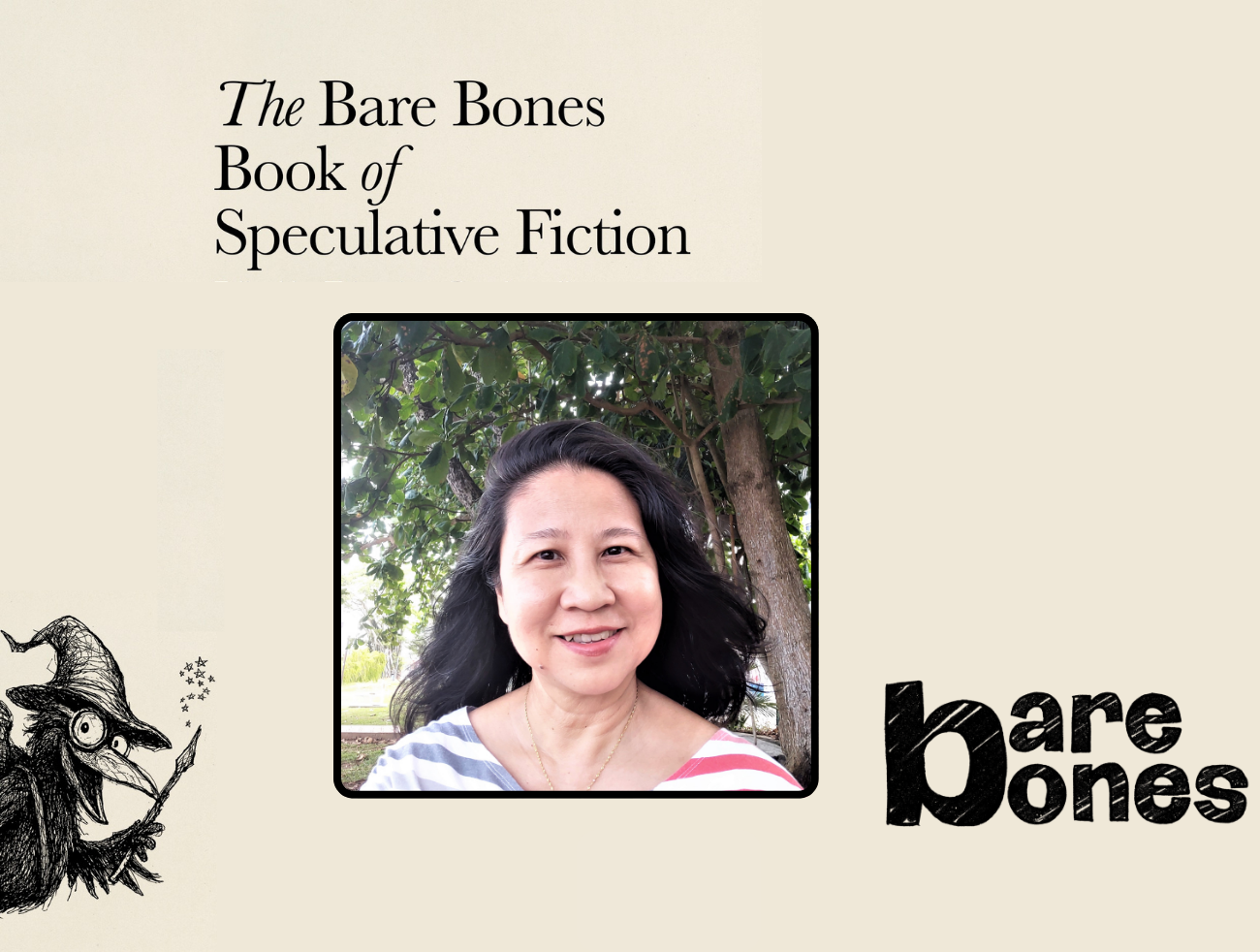
Shih-Li Kow is the Malaysian author of two short story collections (RIPPLES AND OTHER STORIES, BONE WEIGHT AND OTHER STORIES) and a prize-winning novel (THE SUM OF OUR FOLLIES). Her most recent project (KAKI LIMA: PICTURES AND A STORY) is a photo-fiction collaboration with photographer Malek Hue.
Shih-Li’s story ‘Pak Hassan’s Story’—in which an old man narrates the tale of a young fisherman’s tragic love, a by-product of fantastical beings caught in barter—features in THE BARE BONES BOOK OF SPECULATIVE FICTION. The anthology’s editor Tejaswinee Roychowdhury interviewed her to find out about her literary influences.
How do you perceive speculative fiction vis-à-vis the world around you?
I’ll put aside the ‘all fiction is speculative’ stance for this. And I think one of the most enjoyable aspects of speculative fiction, both as a reader and writer, is that it allows a safe space for play, questioning, extrapolation, to say what cannot be said, and to let the imagination run on a long, long leash.
On one level, speculative fiction is escapism, as are many other types of writing. It’s a chance to share someone’s imagination when the writer steps away from normal conventions of realism, and to go to a different time, place, or world. I think sometimes we need this very much.
Yet it is also about what is real. Even the most extreme imaginings are derived, however loosely, from something known: technology, myth, history, climate, nature, beliefs, human emotions, etc. This freedom in speculative fiction to detach or couple the unknown and the known makes it a brilliant vehicle for interrogating what is happening in the real world to real people.
Who and/or what are some of your influences while writing speculative fiction?
As a teenager, I discovered writers like Asimov, Bradbury, and Arthur C. Clarke in old ‘best of’ sci-fi anthologies. I remember coming across ‘Nightfall’ and ‘The Nine Billion Names of God’ and being blown away. These reading years also coincided with the Star Wars, ET, and Back to the Future movies. Imagine coming across all this—space, time travel, aliens, science—in one’s growing-up years!
I believe this taught me to appreciate the many writers and spec-fic journals out there. There are too many accumulated influences. As far as contemporary fiction is concerned, I have to cite Ted Chiang’s short stories as my gold standard for modern SF short stories, and Kazuo Ishiguro’s novels as fantastic examples of how excellent literary and speculative writing do not have to be mutually exclusive.
Tell us about the creative process behind your story.
It started with local idioms. In Malaysia, there is an abundance of Malay similes, metaphors, and idioms in Malaysia. They are evocative, always poetic or pithy, and often humorous. We also have myths featuring warriors, princesses, magic, and natural and supernatural worlds.
I thought it would be fun to write a tall tale in an oral storytelling tone, with some of these elements. I imagined a story built around idioms; a kind of fairy tale told in old sayings and metaphors translated from Malay to English. This sent me down a rabbit hole looking up old idioms.
I became quite enthusiastic because I found many that I had not encountered. Unfortunately, I later felt that I was forcing too many into the story. I also realised that some of these sayings were already stories unto themselves.
As the writing progressed and the story solidified, the narrative became more important than this initial idea. In the end, the few similes that remained came from those that I had learnt and loved in school. For example: skin as smooth as a shelled hard-boiled egg, chattering like magpies that had lost their tail feathers, and a few others. They sound much better in Malay.
Leave a Reply