
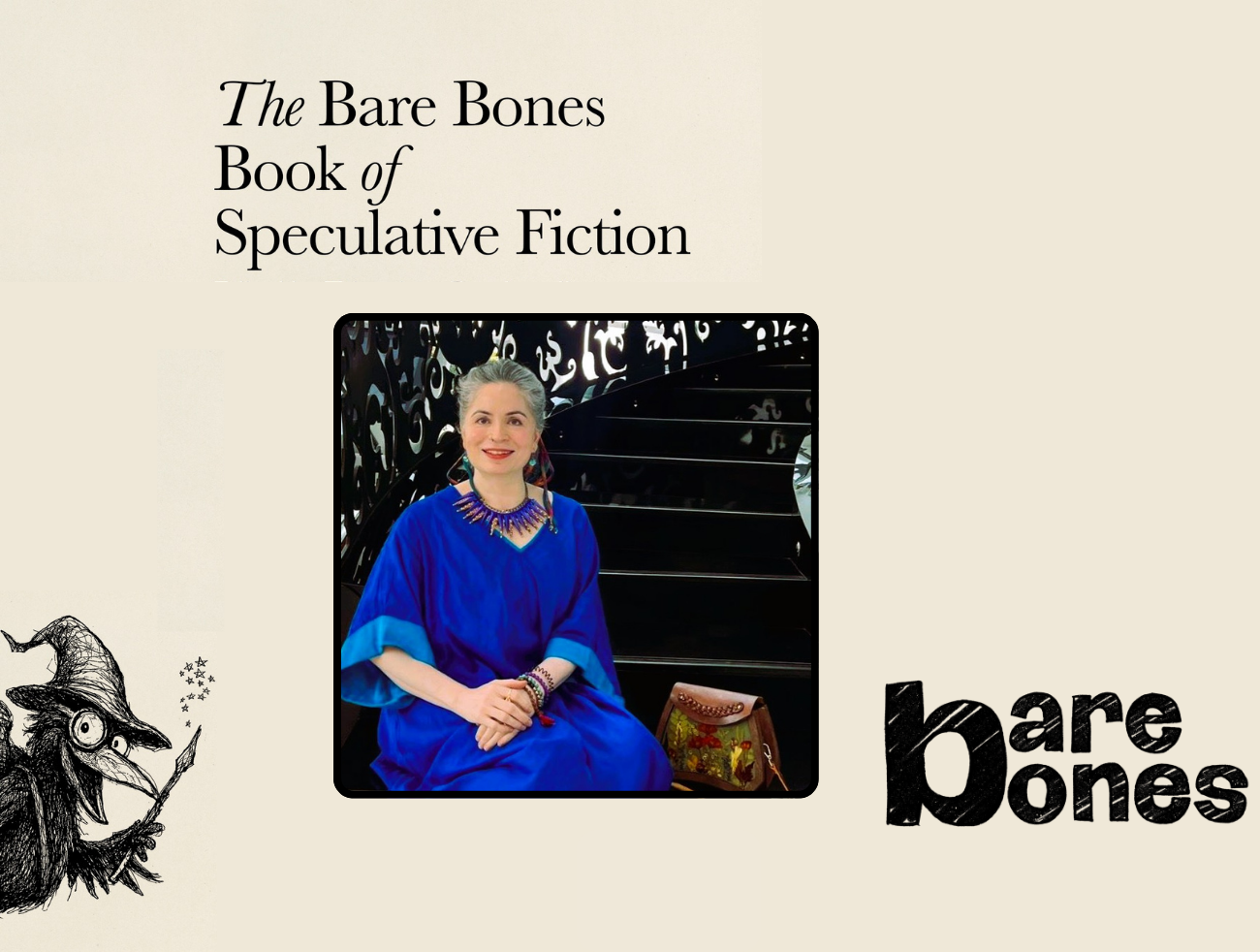
Arti Jain is a poet, an award-winning spoken word artist, and an author. Her most recent work is curated in The Yearbook of Indian Poetry in English 2024–2025, Flash Flood Journal, Spellbinder Quarterly,and is forthcoming in The Hopper and The Amphibian. She lives in Doha and is working on a memoir.
Arti’s story ‘Hide and Seek’—in which a young woman disappears and is perceived to have turned into a goddess—features in THE BARE BONES BOOK OF SPECULATIVE FICTION. The anthology’s editor Tejaswinee Roychowdhury interviewed her to find out about her literary influences.
How do you perceive speculative fiction vis-à-vis the world around you?
This is such a timely question. I’m based in Doha, Qatar. The past six weeks have been stranger than fiction. Sometimes, even bordering on the bizarre. In uncertain times, speculative fiction becomes my escape and muse.
I’ve always enjoyed reading speculative fiction, but it’s during periods of personal or political upheavals that my writing veers into the exploratory world of magical realism. When real life seems surreal, the surreal in art or literature grounds me and gives me hope, reminding me we are also capable of creating beautiful worlds.
Who and/or what are some of your influences while writing speculative fiction?
I tend to dip into the tales from the Ramayana and the Mahabharata my grandparents and parents told us when we were little. When I was five, my mother read a story (in Hindi) to me. It was written from the point of view of a road. The road was urging the commuters to mind their manners and be mindful of its needs. That story left an indelible mark, changing the way I look at inanimate objects to this day.
That early sense of wonder is what draws me to magical realism today. Yann Martel’s LIFE OF PI, Salman Rushdie’s SHALIMAR THE CLOWN, Arundhati Roy’s GOD OF SMALL THINGS, Murakami’s KAFKA ON THE SHORE, and Geetanjali Shree’s TOMB OF SAND continue to inspire me.
Recently, I discovered Aimee Bender, and now I am an ardent fan of her style of writing.
Tell us about the creative process behind your story.
During a writing workshop (Smokelong’s March Micro Marathon, 2024), I wrote a piece titled ‘An Unremarkable Disappearance’. I was experiencing perimenopausal symptoms, and that made me dwell on the societal invisibility of women as they age. Over time, this piece turned into an enquiry into the silent erasure forced upon young girls, starting at the cusp of adolescence.
A trip to Banaras later that year brought out the starkness of how we (as a society) destroy women in real life, yet venerate the Divine Feminine in our temples and tales.
The final story is a mosaic. It blends personal and shared experiences with questions I struggle with—how to address the issue of rising rate of crimes against women? What can I do—what can we? And more importantly, if not now, then when?

Leave a Reply