
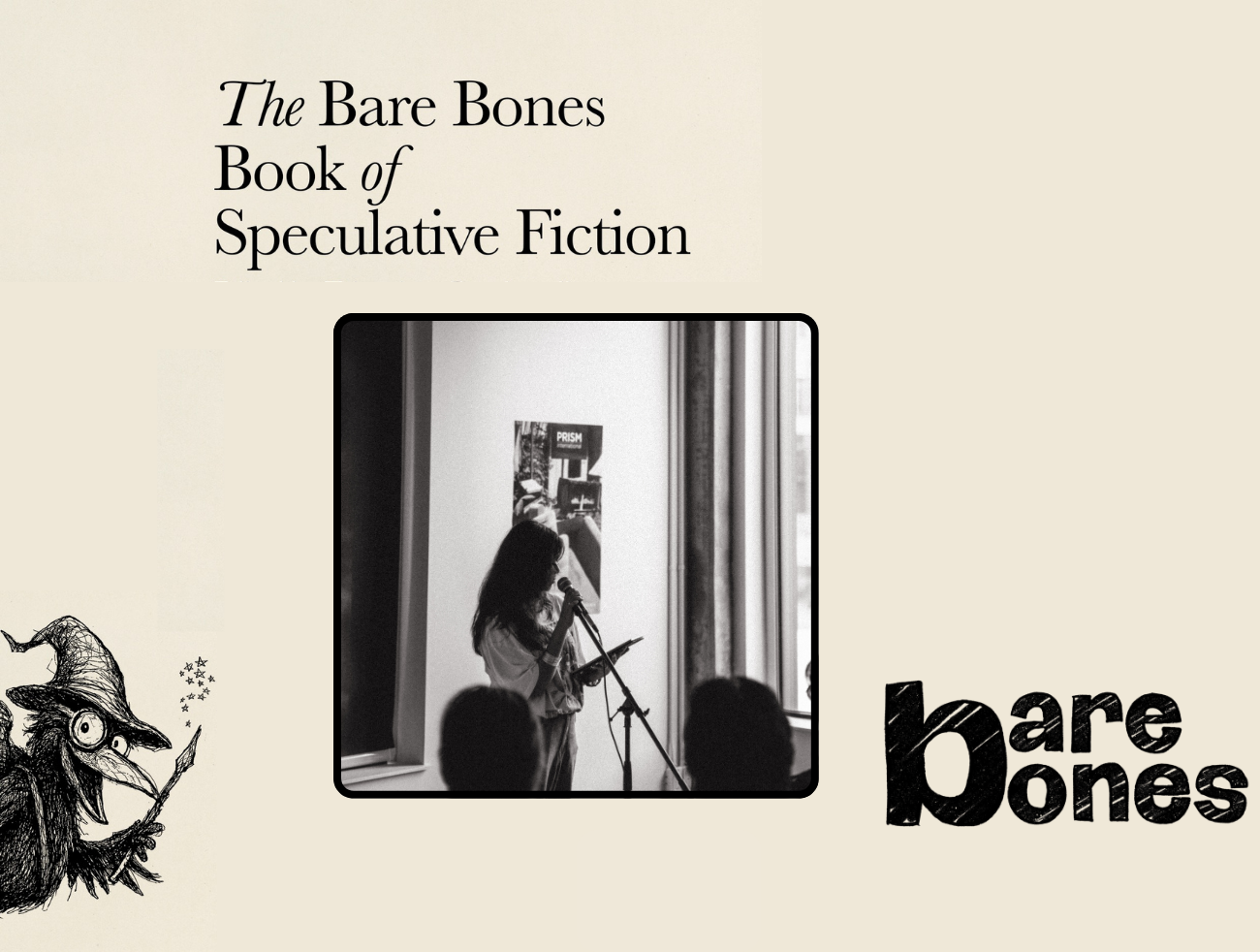
Z. M. Asafzah is a writer and editor stranded in stolen xʷməθkʷəy̓əm, Sḵwx̱wú7mesh, and səlilwətaɬ land in British Columbia. They are at work on a collection of short stories.
Asafzah’s story ‘The Other Son’—in which a mother grieves over the loss of her ‘born wrong’ son, who is replaced by a djinn with a ‘perfect’ one—features in THE BARE BONES BOOK OF SPECULATIVE FICTION. The anthology’s editor Tejaswinee Roychowdhury interviewed them to find out about their literary influences.
How do you perceive speculative fiction vis-à-vis the world around you?
Spec fic, particularly folk horror, allows me to articulate real-world anxieties that are often dismissed or resisted in everyday conversation. It’s not that these fears are difficult to explain; it’s that people’s moral frameworks don’t recognise the humanity of certain groups, such as women, disabled people, children. I feel gaslit when I try to confront beliefs such as the idea, held by many men in my home country, that marital rape is a right.
By displacing these logics into a speculative setting, I can show the violence and absurdity more legibly. The speculative elements create just enough distance for readers to engage with horrors they might otherwise reject, and in doing so, make those realities more visible.
Who and/or what are some of your influences while writing speculative fiction?
I don’t have a helpful answer. My influences are diffuse and accumulative: I read a lot, and my brain squirrels away information and ideas. I also think some of my strongest influences come from film and television, rather than literature; I’ve watched The Haunting of Hill House once, and it won’t leave my thoughts alone.
In literature, Terry Pratchett has shown me how the mundane and the magical are often the same and interchangeable—how the ordinary can be profound, and vice versa. Tamsyn Muir has directed my attention to atmosphere and specificity, and the way they can establish a sense of immediacy in a fictional world. Daphne du Maurier taught me the power of short form and structure in creating, even driving, meaning and mood. Beyond these, I’m also influenced by oral storytelling traditions and the kinds of stories (otherwise known as gossip) that circulate in everyday life. My elders and their penchant for telling stories have had the most influence on my voice and genre.
Tell us about the creative process behind your story.
When I was a child, my driver uncle had to go home because his toddler daughter had gone missing. When he returned, we heard how she was found asleep in a coconut tree. I grew up around these kinds of stories—inexplicable ghotona that coexisted with everyday life. The story came from there.
I do have some reservations about the final piece. Because of its origins and its alignment with folk horror, I felt compelled to set it in a rural environment to ground its atmosphere. However, I didn’t grow up in a rural area, and that distance made it easy to aestheticise village life for literary effect. I’m no longer convinced that was necessary, or entirely responsible. That said, I love and value the story for what it is, and see it as part of my ongoing process as a writer. I will try again.

Leave a Reply