
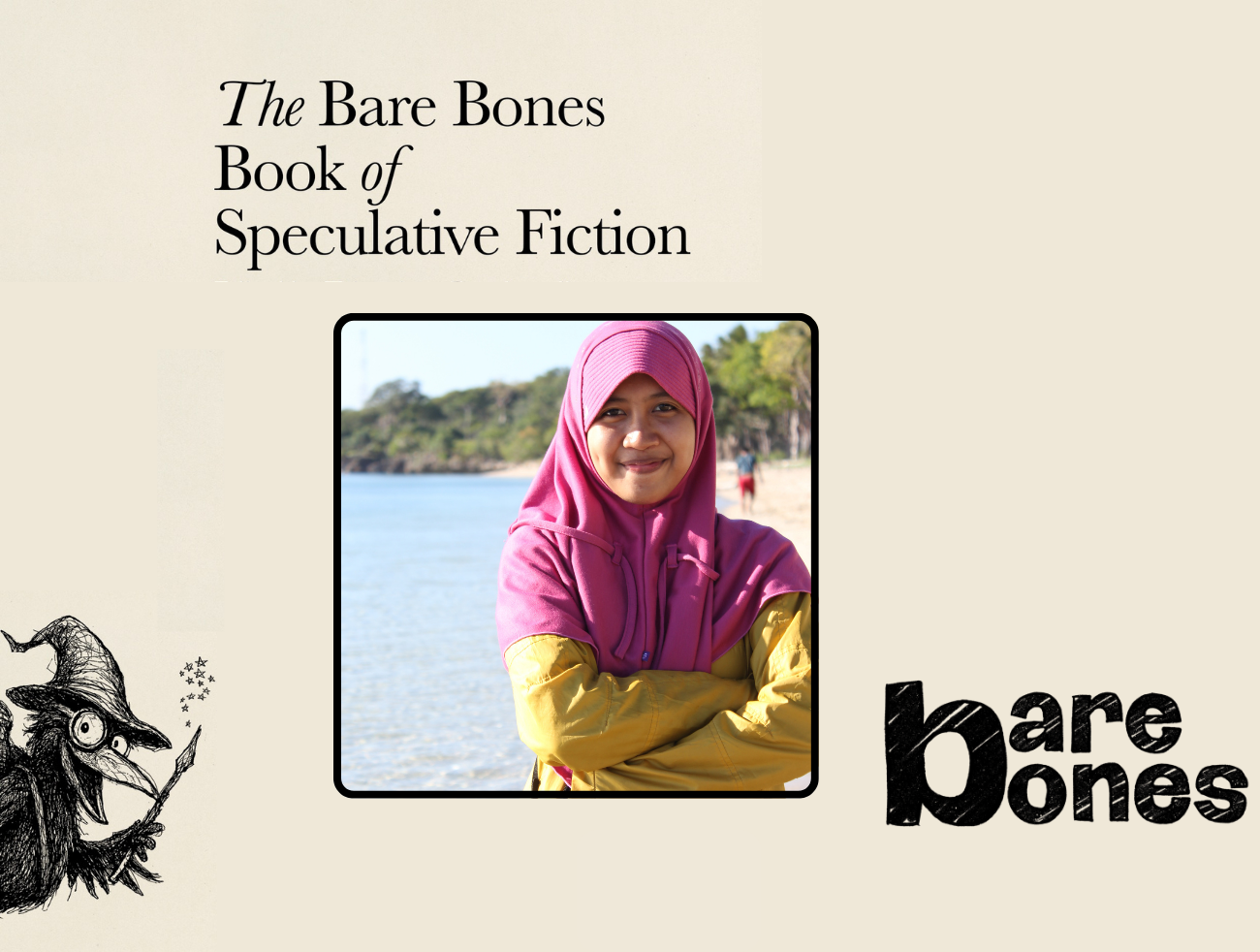
Nurul Fitroh is an Indonesian writer whose works primarily focus on short fiction. Her stories and essays have appeared in both print and online publications. She has contributed to several notable anthologies. In 2019, she was selected as one of the emerging writers at the Makassar International Writers Festival (MIWF).
Nurul’s story ‘Ara’, translated from the Bahasa Indonesian by Wawan Kurniawan—in which a woman experiences death but is unable to describe the simplicity of it—features in THE BARE BONES BOOK OF SPECULATIVE FICTION. The anthology’s editor, Tejaswinee Roychowdhury, interviewed her to learn about her literary influences.
How do you perceive speculative fiction vis-à-vis the world around you?
I see speculative fiction not as an escape from reality, but as another way of looking more closely at it. The world around us is already full of things that once seemed speculative: ecological collapse, artificial intelligence, mass surveillance, political absurdity, and the growing uncertainty about what is real and what is fabricated. In that sense, speculative fiction allows me to take the anxieties, contradictions, and possibilities of the present and push them a little further.
Living and writing in Indonesia also shapes this perspective. Here, the boundaries between the rational, the mythical, the historical, and the supernatural are often more porous than they appear. Speculative fiction gives me the freedom to move across those boundaries. Sometimes, imagining an impossible world is the most precise way to speak about the world we actually inhabit.
Who and/or what are some of your influences while writing speculative fiction?
Franz Kafka is perhaps the strongest influence on my writing. I am deeply drawn to the way his works transform ordinary situations into spaces of anxiety, absurdity, and uncertainty. What fascinates me most is that the strangeness in Kafka’s fiction never feels entirely detached from reality. His characters often find themselves trapped within systems they cannot fully understand, facing rules whose logic remains inaccessible to them. For me, this feels remarkably close to the experience of living in the contemporary world, particularly in societies shaped by bureaucracy, political uncertainty, and unequal structures of power.
Kafka has also influenced the way I approach the absurd. I do not see absurdity merely as something strange or surreal, but as a way of revealing the hidden logic—or illogic—of everyday life. As a writer, I am interested in placing characters in situations where reality slowly becomes unfamiliar, while still remaining emotionally believable.
Tell us about the creative process behind your story.
The story began with an image or an uneasiness rather than a complete plot. This is often how I work: I become preoccupied with a particular image, question, or contradiction, and then allow the story to grow around it. I usually do not begin by knowing exactly where the story will end. Instead, I follow the characters and the atmosphere while gradually discovering the deeper question that the story is trying to ask.
During the writing process, I move back and forth between imagination and research. Even when a story contains speculative elements, I want its emotional and social world to feel grounded. I pay attention to details from everyday life, history, politics, memory, and sometimes scientific or psychological ideas, and then allow these elements to interact with the speculative premise.

Leave a Reply